Who Really Carries the Childcare Load in the Legal Profession?
Posted in Latest News on 1 Sep 2026
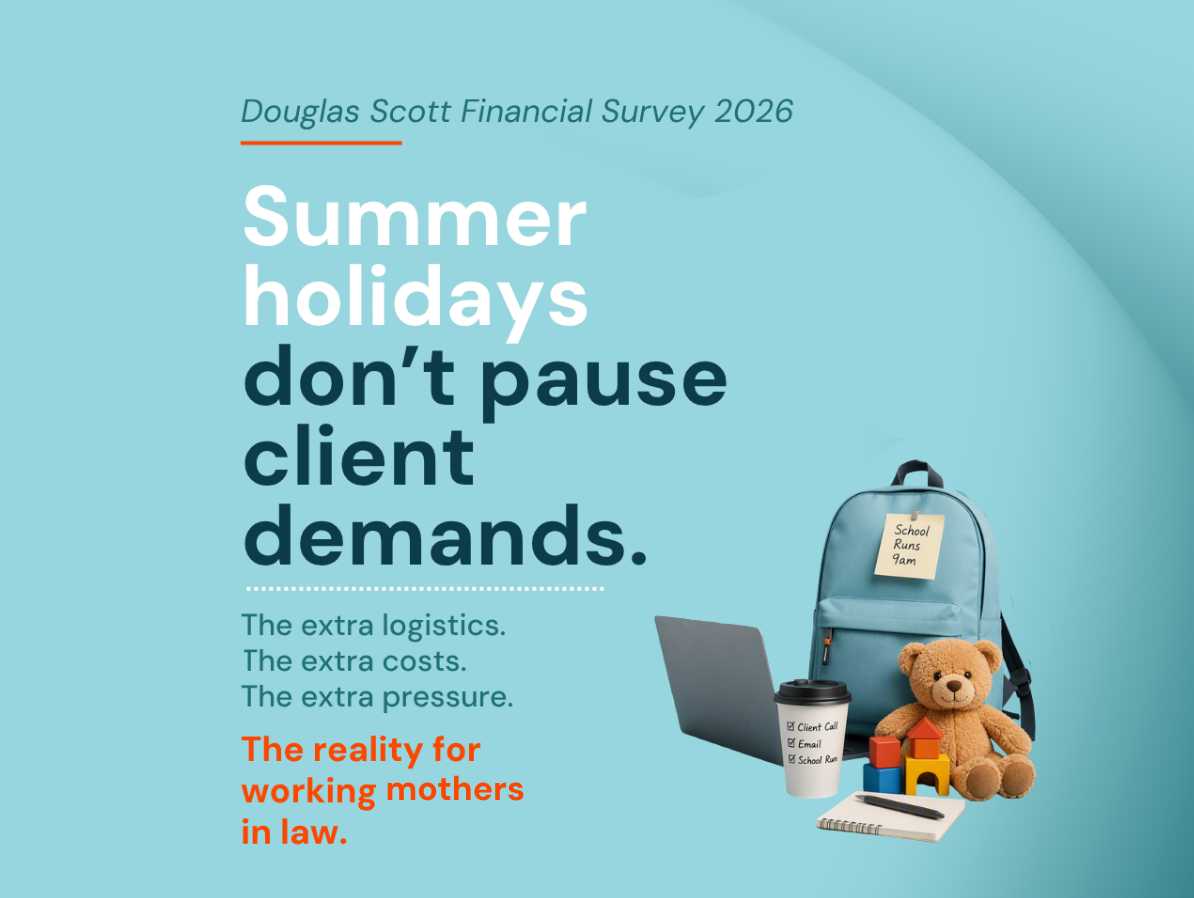
Every September brings a familiar sense of relief for working families. School routines return. The long stretch of summer childcare ends. Yet behind that collective exhale sits a more complicated question about who has been doing the heavy lifting during those six weeks.
Children in the United Kingdom spend almost 18% of the year on school holidays. That is a significant amount of time for parents to arrange holiday clubs, coordinate with relatives, book annual leave, and manage the inevitable gaps when plans fall through. These tasks do not simply happen on their own - someone has to make them happen. New findings from Douglas Scott Legal Recruitment’s Salary Survey suggest that this responsibility is far from evenly shared.
The survey shows a clear divide in how childcare responsibilities are experienced within legal households. 42% of women in law say they carry most of the childcare responsibilities, whilst only six per cent of men say the same.
Another set of figures adds a further layer. 71% of men believe childcare responsibilities are shared equally. Only 46% of women agree. The gap is not only in the workload - it is in the perception of the workload.
This raises an important question about how equality is being defined. Childcare is not only the visible tasks such as school runs and pick-ups. It is also the invisible labour that keeps everything functioning, such as planning, scheduling, anticipating and troubleshooting. Sociologists often describe this as the mental load. It is a form of cognitive labour that is easy to overlook because it is designed to prevent problems before they arise.
Aimee Rwathore, Customer Relationship Manager at Douglas Scott Legal Recruitment, has worked through having two children. "Childcare isn’t just about who does the school run or takes a day off when a child is ill. It’s also about who’s thinking ahead about the school holidays, booking the clubs, sorting out cover and figuring out what happens when Plan A falls through. That mental load can be easy to miss, but it still takes time and energy. As a working mum, I’ve learned that sharing childcare equally also means sharing the responsibility for planning and organising it too."
In many households, the mental load is carried more heavily by women, and the demands of the legal profession may intensify that imbalance.
One explanation may be visibility. Practical childcare tasks are easy to quantify. The organisational work behind them is less tangible. Booking holiday clubs months in advance, coordinating grandparents, rearranging annual leave and managing last-minute cancellations. These tasks often happen quietly and outside office hours. If one partner is doing more of the visible tasks, they may feel the division is equal. If the other partner is carrying the invisible tasks, they may experience the load very differently.
Cultural expectations also play a role. Women in professional roles often describe feeling an implicit responsibility to hold everything together, even when both partners work full-time. Men may feel they are contributing equally by being available when needed even if they are not the primary organiser.
The structure of legal work adds further pressure. Long hours and client demands can make flexibility difficult. For many women, this means absorbing more of the domestic planning to protect their professional commitments. For many men, it may mean assuming their partner is better placed to manage the household logistics.
The legal profession spends considerable time discussing gender representation and the retention of female talent. But career progression is shaped not only by what happens inside the office: it is shaped by what happens before the working day begins, during school holidays, and long after the laptop closes.
If one group consistently carries more of the childcare burden, both visible and invisible, it affects their capacity to take on additional responsibilities or pursue promotions. It shapes stress levels and burnout risk, and it influences long-term decisions about career direction.
The summer holiday data highlights how deeply domestic responsibilities intersect with professional outcomes. The childcare gap and the leadership gap are not separate issues - they are connected.
The first step may be acknowledging the discrepancy. If men and women perceive the division of childcare so differently, it becomes harder for workplaces to design policies that genuinely support working parents. Flexible working and predictable hours can help, but only if organisations recognise the uneven load many women carry.
There is also a cultural shift underway. Younger legal professionals increasingly expect shared domestic responsibilities and are more vocal about work-life balance. Yet cultural change moves slowly, and the data suggests traditional patterns remain.
The conversation about childcare in the legal profession is not a side issue. It sits at the centre of how talent is supported and how careers are shaped. The figures from the survey show that many women are carrying responsibilities that remain largely invisible in professional settings. They also show that men and women often see the same situation very differently.
If the profession wants to retain female talent and close the leadership gap, it must first recognise the care gap that exists long before anyone steps into the office. The summer holiday data makes that reality clear. Until the invisible work of childcare is acknowledged and shared more evenly, the same patterns will continue to repeat. This is not only a question for families. It is a question for employers and for the wider culture of legal work. The profession has an opportunity to examine the pressures that shape the lives of working parents and decide whether it wants to support a more balanced future. The next step is honest recognition. Real change can only follow once the full picture is understood.
Latest insight
-
5 key changes shaping the legal industry this year.
17 Nov 2025 -
What makes a standout legal candidate in today’s market?
18 Aug 2025 -
Why Legal Support is moving into family and corporate law
14 Aug 2025 -
Are you a two-year PQE? You’re in demand! Make that work for you
17 Jul 2025 -
Why a solid in-house team is vital in retail
08 Jul 2025